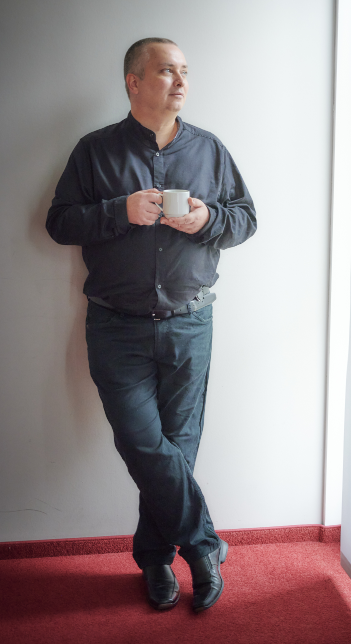
Wulf C. Krueger
I have spent most of my professional life at the point where deep technical work, large-scale workplace infrastructure, and long-term standardisation meet.
My path into information technology did not begin in a boardroom, or through a formal computer science track. It began in the 1990s, in the practical, hands-on world of systems, networks, operating systems, and the kind of technical curiosity that comes from wanting to understand how things actually work. In March 1995, I replaced my last OS/2 Warp system with Linux. That was not just a change of operating system. It was the start of a much larger journey. What began as technical interest became a lasting commitment to building, maintaining, questioning, and improving complex systems, both professionally and in the world of free and open-source software.
After completing my Abitur in 1995, and following civilian service, I studied German Philology, English Philology, and Media and Communication Studies in Göttingen. At the same time, however, I was already moving steadily into practical technical work. My early professional roles included system administration, network support, consulting, hardware maintenance, server administration, and user-facing technical problem-solving. I worked in and around Göttingen, Holzminden, and Hardegsen, supporting both internal infrastructure and client environments, often in small or mid-sized organisations where versatility mattered as much as technical skill.
Those years taught me something that has stayed true throughout my career: technology only becomes valuable when it works in the real world, under real constraints, for real people. Elegant ideas are useful, but reliability, clarity, maintainability, and practical outcomes matter more.
From late 1998 onwards, my career took on a more structured direction with Mentopolis Consulting & Software Concepts GmbH. What began with internal information technology and security-oriented consulting developed into nearly a decade of quality management, workplace technology, migration strategy, standardisation, testing, and enterprise consulting. Much of this work took place in the orbit of Deutsche Telekom and its wider technology environment. It was here that I learned how to operate not merely at the level of individual systems, but at the level of entire platforms, fleets, processes, and organisational interfaces.
I worked on migrations from older client platforms to Windows NT environments, on test management in complex integration scenarios, on Year 2000 readiness, on software distribution strategies, on configuration and incident management, and on the technical and strategic evaluation of Linux in enterprise desktop settings. I was involved in the design of structured workplace testing approaches, in the assessment of new tooling, and in the optimisation of standard workplace production. In other words, I was already doing the sort of work that would define much of my later career: translating technical complexity into workable standards, processes, and decisions.
At the same time, my engagement with Linux never remained merely professional. It also became part of my public technical identity.
In the late 1990s and early 2000s, I moved beyond simply using Linux and began exploring it more fundamentally, including Linux From Scratch and Beyond Linux From Scratch. That phase mattered because it deepened my understanding of systems from the inside out. It is one thing to administer a distribution. It is something quite different to build one, understand its moving parts, and think about what a coherent operating system ought to be.
That line of interest eventually led me into distribution development. In 2007, under the nickname Philantrop, I became active as a Gentoo developer, particularly in the KDE area. My time there was intense, productive, and formative. It also ended abruptly. Shortly afterwards, Exherbo became the project in which much of my free and open-source work found its real long-term home.
Exherbo was not a side hobby. It was a serious technical commitment, and one that lasted for years. I helped build and maintain the distribution in an international team, and Exherbo became one of the central threads in my technical life. The project reflected much of what I value in systems work: clarity, technical honesty, developer-minded design, and a willingness to rethink conventions instead of merely inheriting them. Public contribution records show how substantial that work became over time, but the numbers are less important than what the project represented. Exherbo was a place where distribution engineering, tooling, systems thinking, and philosophy of design came together.
Professionally, I joined T-Systems in June 2007, and from there continued to grow into increasingly responsible roles across quality assurance, technology consulting, workplace standardisation, and operational leadership. My work covered pre-sales, strategic technology input, technical evaluation, large-scale standardisation initiatives, benchmark leadership, offshore integration, and quality assurance in complex enterprise environments. I was closely involved in the standardisation of workplace systems in the Deutsche Telekom world, including major transitions such as the move to Windows 7, as well as broader programmes dealing with consistency, compliance, and technical governance across large environments.
Over time, that work moved further into leadership. I served in acting and deputy leadership roles in Quality Assurance and later in Cloud Workplace Management. I led or helped lead initiatives around application readiness, compatibility validation, and operational process development. Between 2019 and early 2020, I worked at operational services GmbH & Co. KG, before returning to Deutsche Telekom IT GmbH. Since then, my work has continued at the intersection of workplace strategy, application compatibility, architecture, and operations.
My more recent responsibilities have included browser and application architecture, standard workplace policies, compatibility governance, operational stability, security-related process adherence, and advisory work across business and technical units. In 2025, a formal reference described me as the responsible Solution Architect for browser solutions, with strategic and technical responsibility for browser architecture in the enterprise environment, and with significant responsibilities in operations, standards, and cross-functional optimisation. That description fits well with how I see my own role: I work best where technical depth and structural responsibility meet.
What has remained consistent throughout all of this is a certain kind of technical temperament.
I am interested in systems as systems. I care about architecture, but also about the operational consequences of architecture. I care about standards, but only when they help people work better, more safely, and more coherently. I care about free and open-source software not as branding, but as a space for technical seriousness, transparency, autonomy, and craftsmanship. I enjoy solving difficult problems, but I also value the quieter work of making things maintainable, understandable, and dependable.
The documentary trail of my career, through résumés, references, public project history, and long-standing technical work, points to a profile that does not fit neatly into a single label. I am not only a systems administrator, not only an architect, not only a consultant, and not only an open-source contributor. The common thread is that I have spent decades working on the structure beneath the visible surface: the standards, tools, platforms, integrations, and decisions that determine whether technology holds together under pressure.
From early Linux and enterprise migrations, to Gentoo and Exherbo, to workplace architecture and operational responsibility in one of Europe’s largest corporate technology environments, my work has always followed the same instinct: understand the system deeply, improve it carefully, and leave it in a better state than I found it.
If technology is, at its best, a form of long-term thinking made practical, then that is the kind of work I have tried to do all along.
