Platform Decay (The Murderbot Diaries #8), by Martha Wells
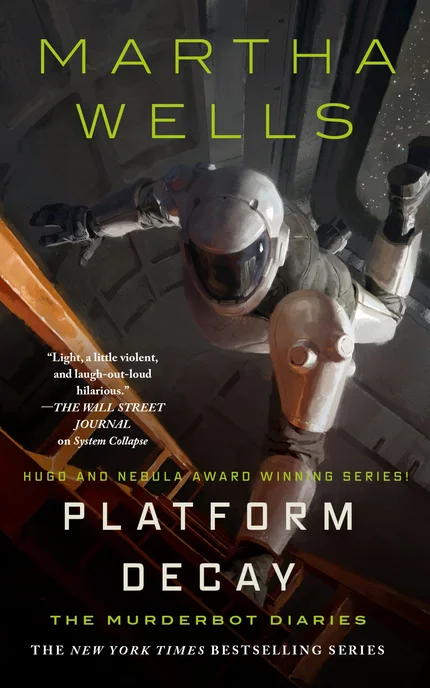
Platform Decay by Martha Wells
My rating: 3 of 5 stars
Platform Decay should have felt like a homecoming. Instead, it feels like being shoved out of an airlock and told to keep up.
I absolutely loved Murderbot at its best. The early books worked because the action was never really the point, or at least never the whole point. The point was the anxious, avoidant, furious, funny, traumatised self hiding underneath the armour. Murderbot was compelling because every mission doubled as self-exploration: what does freedom mean, what does personhood mean, what does friendship mean when even admitting you have friends feels like an exposed nerve?
“Platform Decay” knows that version of the series still exists, but it only lets us see it in flashes.
»”SecUnit.”«
That one word, from Mensah, carries more emotional weight than whole stretches of the surrounding plot. Likewise, the late moment where Murderbot acknowledges being surrounded by friends is exactly the sort of subtle, painful, beautiful interior work that made me fall so hard for these books in the first place. The trouble is that there simply is not enough of it. It feels less like the emotional spine of the novel and more like a reminder of what the series used to do effortlessly.
The book’s opening does not help. We are dropped straight into motion with almost no easing-in, no meaningful recap, no reorientation. Either we swim with the story or drown, and honestly, that sucks. It is also getting old. A long-running series can trust its readers without treating momentum as a substitute for grounding. Here, the immediate plunge into action feels less exhilarating than exhausting.
The actual flight story is, sadly, mediocre. It has danger, urgency, hostile forces, difficult humans, and the usual Murderbot competence under stress, but too much of it feels like functional movement rather than emotional discovery. There is suspense, yes, but suspense alone is not what makes Murderbot special. If I only wanted frantic space action with snark, science fiction has plenty of that. What Martha Wells gave us in “All Systems Red” (review), “Artificial Condition” (review), and “Network Effect” (review) was sharper and rarer: action filtered through a consciousness that was learning, against its will, how to be a person.
Compared with those earlier books, “Platform Decay” feels thinned out. The voice is still recognisable, and there are still good lines, especially when Mensah or her family enter the emotional field. The observation about Mensah’s partners being just as stubborn and determined as she is has that old warmth: political texture, relationship texture, and Murderbot’s grudging admiration all at once. It is a faint echo of the glorious past, and that phrase really is the problem. Echoes are not enough.
It also sits uncomfortably beside “Fugitive Telemetry” (review) and “System Collapse” (review), both of which already suggested a shift away from the delicate interiority that made the series exceptional. Those books were more action- and suspense-forward too, but “Platform Decay” makes the drift harder to ignore. It is not that Murderbot must remain static. Quite the opposite: I want more growth, more awkward self-knowledge, more of the terrifying intimacy of being cared for. I want the series to follow the implications of what it has already built.
As a science fiction adventure, this is readable. Compared with lighter, action-led genre pieces like John Scalzi’s “Starter Villain” (review), it still has the advantage of a far more interesting central voice. Compared with something like “Bots of the Lost Ark”, which uses artificial intelligence and mission structure with a clean little emotional hook, “Platform Decay” feels oddly overbusy and undernourished. It has the machinery of a good Murderbot story, but not enough of the inner weather.
I did not hate it. I still care about Murderbot, Mensah, and the fragile social world around them. But caring about them is precisely why this disappointed me. The book gives us glimpses of the self-exploration I came for, then hurries back to the less interesting business of movement and threat.
Sadly weak, then. Not a disaster, but a comedown. Less stupid action, more self-exploration of Murderbot, please.
Three stars out of five.
Ceterum censeo Putin esse delendam
View all my reviews

