Talking to the Dead (Fiona Griffiths #1), by Harry Bingham
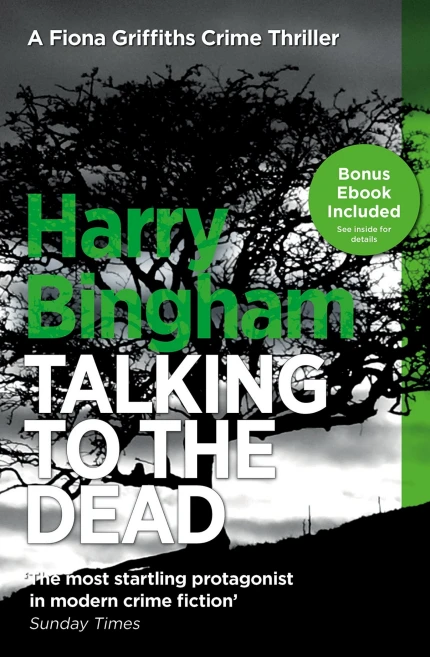
Talking to the Dead by Harry Bingham
My rating: 3 of 5 stars
This was an odd, sometimes compelling, sometimes exasperating mix of police procedural and psychological thriller, and it never quite decides which one it wants to be. The result, for me, is a book that kept pulling me along, then tripping itself up.
The premise is undeniably strong: a “damaged”, hyper-observant detective-in-training, a grim Welsh setting, a dead girl who does not stay neatly dead (at least, not in the way the narrative wants her to), and a mystery with enough hooks to keep the pages turning. When Bingham focuses on the investigation, the novel has that familiar genre satisfaction: clues, reversals, institutional friction – albeit with a slightly skewed angle that separates it from the more straightforward, momentum-first crime writing I usually enjoy.
»I tell him that there’s one man dead, and four others, who might or might not be dead by the time help arrives.«
My main problem with this novel is its pacing. Scenes that ought to tighten the screw sometimes drift, and moments that should land as unsettling tip into something that feels faintly absurd. “Weird” can be a strength in crime fiction – think of how certain Nordic noirs let bleakness curdle into the uncanny – but here it often felt like a pacing substitute rather than an intentional mood.
»I’m standing next to them in my long white gown and ridiculous boots, feeling like an extra from some low-budget horror movie, when I notice that my heart is fluttering.«
And then there’s Cotard’s syndrome. Yes, the book tries to justify it, but it is so exceedingly rare that leaning on it this heavily starts to feel like narrative cosplay: a clinical label dragged in to make the protagonist more “special”, rather than more believable. I’m all for damaged detectives, but I want the damage to deepen the story, not periodically derail it.
»Cotard’s syndrome.” Brydon stares at me, somber and without judgment.«
I also struggled with the voice in a way I can’t fully separate from authorship: at times, it felt like a male writer “writing” a female protagonist, rather than a woman speaking on the page. It’s not constant, but when the narration lingers on the arrangement of clothing and hair, or frames a dead body in terms of how it might look “to best advantage”, it pulls me out of Fiona’s head and into the author’s hand.
I’ve also read many reviews that call Fiona “quirky”. She isn’t. “Quirky” is the word you reach for when you want to domesticate discomfort – when a behaviour is odd, but you would rather frame it as charming eccentricity than sit with what the text is insisting upon.
If we take “Talking to the Dead” at face value, Fiona is not doing manic-pixie flourishes, or being whimsically offbeat for colour. She is living with something the book repeatedly positions as a profound, disorienting disruption of selfhood. Her coping mechanisms, affect, and decision-making are not narrative seasoning; they are the point. To call that “quirky” is to shrink an illness into a personality trait.
The core issue is language as ethics: labels decide whether we are taking a character’s suffering seriously, or turning it into a cute tic for our entertainment. A “quirky” protagonist asks you to smile indulgently. Fiona, as written, asks you to reckon with the cost of her condition, and with how everyone around her either accommodates it, exploits it, or quietly looks away.
I probably won’t continue this series, despite Fiona being an interesting character. This opener is a messy mix of procedural bones and (to me, unconvincing) psychological garnish, and that split – between the satisfying mechanics of a crime novel and the insistence on a psychiatric “hook” – is exactly where the book’s identity crisis lives.
Three stars out of five.

