The Burning Land (The Last Kingdom #5), by Bernard Cornwell
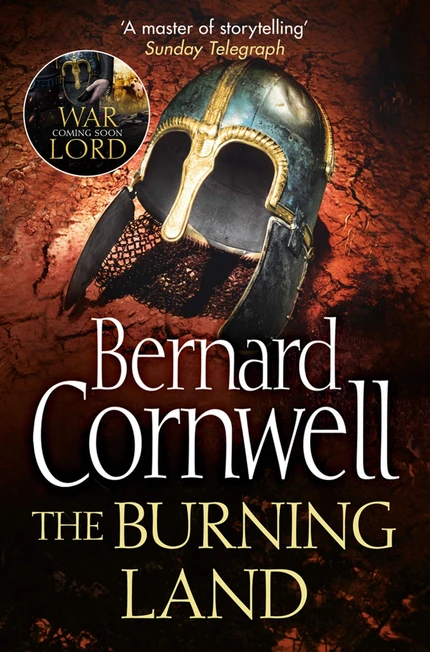
The Burning Land by Bernard Cornwell
My rating: 5 of 5 stars
“The Burning Land” is exactly what I wanted from the fifth book in Bernard Cornwell’s Saxon series: another fierce, fast-moving Uhtred adventure that keeps all the strengths of its predecessors while avoiding the weaknesses that occasionally slowed them down. I liked it very much indeed. More importantly, I enjoyed the entire journey. Every page gave me something: a battle, a sharp exchange, a political manoeuvre, a religious hypocrisy, or one of Uhtred’s wonderfully blunt observations.
The setup is familiar but still effective. Alfred is ageing and ill, his heir remains untested, and the Danes see an opportunity to press their advantage. Uhtred’s position between Saxon and Dane, loyalty and independence, remains the engine of the story. Cornwell understands that Uhtred is most interesting when nobody can quite claim him, least of all Uhtred himself. His decisions feel personal, practical, and gloriously dangerous without making him seem stupid for the sake of excitement.
»The way to wealth is to become a Christian bishop or a monastery’s abbot«
That irreverent view of religious power is one of the book’s pleasures. Cornwell’s medieval world is devout, violent, politically calculating, and often hilariously cynical. The humour never breaks the atmosphere; it grows naturally from the gap between pious language and the greed, ambition, and brutality underneath it. I especially enjoyed the way institutions are treated as things people manipulate, rather than as moral authorities the narrative expects me to admire.
Compared with other historical fiction, this is unusually immediate. The history is present in the landscape, the rival kingdoms, and the competing claims of faith, but it never turns into a lecture. Compared with straightforward military adventure, it gives equal weight to persuasion, betrayal, inheritance, and political calculation. The battles matter because of what they change, not merely because Cornwell can describe them brilliantly, although he certainly can.
That balance is particularly welcome in historical fiction, a genre that can sometimes confuse scale with depth. Cornwell keeps the political map comprehensible because every alliance has a face, and every shift in power affects someone Uhtred knows. The result feels lived-in rather than merely researched, and the violence has consequences without becoming a sermon.
It also feels remarkably even when set beside the earlier books. “The Pale Horseman” had that extended, bleak swamp passage; “Lords of the North” briefly lost me during its captivity section. “The Burning Land” has the raw energy of “The Last Kingdom” and the humour of “Sword Song”, but I never felt it dragging or taking a detour I wanted to escape. It is not simply more of the same. It is the series settling into a particularly confident rhythm.
After five books, I might reasonably have expected some fatigue. Instead, I finished this wanting more Uhtred immediately. That is the clearest verdict I can give. “The Burning Land” is savage, funny, politically sharp, and consistently entertaining. For me, it is not merely another good instalment. It is the most balanced book in the series so far, and the first one that gives me no obvious weakness to set against its many pleasures.
Five stars out of five.
Ceterum censeo Putin esse delendam
View all my reviews

