The Co-op, by Tarah DeWitt
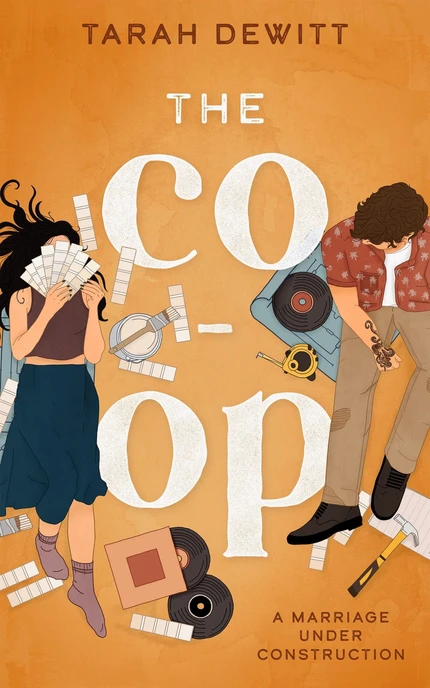
The Co-op by Tarah DeWitt
My rating: 3 of 5 stars
Tarah DeWitt’s “The Co-op” was a strange reading experience for me. On paper, it should have been effortless: a contentious teenage fling, a decade of distance, then shared ownership of a dilapidated Santa Cruz building that forces LaRynn Lavigne and Deacon Leeds into proximity and co-operation. In practice, it kept oscillating between “this has real spark” and “why is this not doing more with what it has?”.
I felt compelled to keep going because the book does have moments that are tender, funny, and quietly recognisable. It had its moments, but the gaps were glaring.
At its best, it sketches LaRynn with a sharp self-dislike that rings true, and it lets Deacon’s antagonism come edged with understanding.
»Even at eighteen, half a step into adulthood, she was permanently on the verge of a fight, nothing and no one around her ever good enough.«
The bigger structural issue is how often the story chooses summary over scene. For a romance that frames itself around renovation, the renovation itself rarely generates the mess, pressure, or teamwork that would naturally deepen the relationship. There are long stretches where the work is discussed after the fact, but very little is actually shown happening, so the emotional beats can feel oddly weightless.
Despite being shorter than many comparable contemporary romances, it still has lengths. The setting invites escalation, surprises, and tangible consequences, and I kept waiting for the story to use its own premise as an engine.
LaRynn’s pettiness, in particular, did not read to me as charming or cathartic. I found it offending and annoying, and the toothbrush moment crystallised the problem.
»And then “we” shrugged in unison before I scrubbed the toilet good and hard with his toothbrush because fuck him that’s why.«
If the book had consistently held her accountable, or used the renovation setting to force a more meaningful reckoning, I could have gone with it. Instead, I often felt the narrative smoothing over behaviour that made me want to disengage.
Where the novel did work for me was in its occasional awareness of how awkward adulthood can feel, especially when you are trying to do the right thing while still half stuck in old patterns.
»Maybe we’re just not very good at our impressions yet.«
And there are flashes of intimacy that are genuinely persuasive, especially in the quieter domestic moments. (LaRynn quietly enters the same room and Deacon doesn’t see but feels it. This is something I can strongly relate to (unless I’m reading a better novel than this one!).)
»A personal source of gravity.«
Unfortunately, the prose-level carelessness kept knocking me out of the story, and nothing irritated me more than the repeated misuse of “I” and “me”. “My mother and I’s relationship” is something I shudder to hear in real life. Having to read it in a novel was disgusting.
»There’s something to love here, in this place where my mother and I’s relationship exists.«
(I still feel the red-hot fury boiling while writing this review!)
I also appreciated the absence of a big, manufactured third-act breakup. Still, even that could not compensate for the sense of lost opportunity in the main body.
One of the few places where “The Co-op” genuinely crystallises its own intent is late on, when LaRynn admits, »I know that love will, too. But I’m starting to think that’s the whole point, finding the person or people who’ll fight and dream with you.«
It is a good line, and it briefly made the book feel more substantial than it often does, because it points beyond the easy romance beats towards partnership as something active and chosen.
For me, that moment also underlined what the novel only intermittently earns on the page: not just “fighting and dreaming”, but growing together, and accepting that both people will change, with love either expanding to hold that change or faltering under it.
If there’s anything both my wife and I’ve learned in almost 27 years of marriage, it’s that change is not only inevitable, but something to embrace, to celebrate with each other, and to cherish. Max Frisch makes a similar point in his diaries: love lives in the willingness to accompany someone through their transformations, rather than clinging to a fixed picture of who they are. That, to me, is the grown-up version of romance: not the promise that nothing will change, but the choice to keep meeting each other honestly as you both change.
Yes, long-term love is a decision, made again and again.
If you want a renovation-adjacent, forced-proximity contemporary romance, there are richer, more scene-forward options. Ali Hazelwood and Liz Tomforde both deliver cleaner on-page payoff than this.
This is my first Tarah DeWitt, and it will also be my last.
Three stars out of five.

