Every Heart a Doorway (Wayward Children #1), by Seanan McGuire
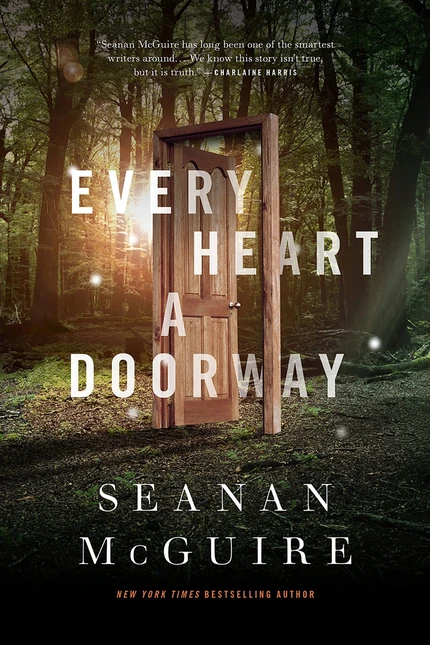
Every Heart a Doorway by Seanan McGuire
My rating: 5 of 5 stars
Not the fantasy of going through the door, but the heartbreak of coming back.
Every portal fantasy asks what lies beyond the door. What Seanan McGuire asks instead is what happens after the door shuts behind you, and that shift gives “Every Heart a Doorway” its bruised, peculiar power.
»Children have always disappeared under the right conditions.«
I went in expecting something wistful and whimsical. What I found was weirder, sadder, and much sharper about loneliness, belonging, and the violence of being told that your deepest truth is nonsense.
»Narrate the impossible things.«
That line feels like the novella’s method in miniature. McGuire writes with the economy of a fable, but not the emotional simplicity of one. The prose is lean, clean, and surprisingly cutting. Eleanor West’s school is not a cosy sanctuary for charming misfits so much as a halfway house for children who have already found the worlds that suited them, and then lost them. That idea could easily have become twee. Instead it becomes tender and slightly savage. My final note called the book weird, full of empathy and emotion, and that still seems exactly right: it has a good-heartedness that never slips into softness.
»Outside the norm.«
What I liked most is how firmly the book sides with its outcasts. That highlighted phrase catches the moral centre of the novella. McGuire keeps returning to the cruelty of forced normality, to the way adults pathologise difference and peers weaponise it. Nancy’s stillness, Kade’s ease in himself, Sumi’s chaotic brightness, even the school’s prim rules all feed into a story about misfitting in very specific ways. For such a short book, it makes room for a surprising amount of identity, ache, and solidarity.
»”This world is unforgiving and cruel to those it judges as even the slightest bit outside the norm.”«
The murder plot gives the novella its sharpest edge, but I like that the horror is less about puzzle mechanics than about desperation. McGuire understands how unbearable longing can curdle into something monstrous.
»The things she’s experienced… they change a person.«
The marvel is not the worlds behind the doors, but the psychic wreckage left when those worlds are out of reach, possibly forever.
»You are the guardians of the secrets of the universe.«
On the strength of this novella alone, McGuire seems unusually good at making strangeness feel both precise and humane. As a person who is thoroughly “strange” myself, I appreciate that all the more.
Five stars out of five.
Ceterum censeo Putin esse delendam
View all my reviews


2 thoughts on “Every Heart a Doorway (Wayward Children #1), by Seanan McGuire”