Wicked Women (D.I. Kim Stone #23), by Angela Marsons
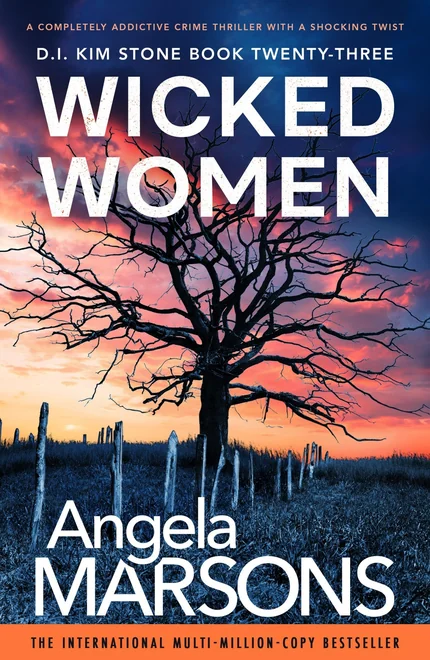
Wicked Women by Angela Marsons
My rating: 5 of 5 stars
“Wicked Women” is one of those rare long-running-series instalments that makes you feel, within a handful of pages, that you have come home. As the twenty-third novel in the Detective Kim Stone series, it has every right to coast on familiar beats, but it does the opposite.
Angela Marsons drops you straight back into Kim Stone’s world with that familiar, brisk authority – sharp observation, sharper dialogue, and a case that refuses to sit still.
The premise flirts with witchcraft, but the book’s real trick is how elegantly it keeps the supernatural at arm’s length: present as culture, performance, fear, and suggestion, yet never allowed to bulldoze the procedural logic. Like Kim, I do not believe in witches, and I loved how the novel leans into that scepticism while staying delightfully ambiguous.
»‘But no one really believes in them,’ Kim stated.«
That line sets the tone: we are here for evidence, motives, and human choices, not for easy explanations. Even when “witches” turn up in conversation, they function as a lens – on community, on misogyny, on the stories people tell themselves, and on the harm that can hide behind the theatrics.
What I appreciated most is how the book refuses to answer the wrong question. It is not “are witches real?”, but “what do people do when they want power, belonging, or someone to blame?” That is why the ambiguity feels earned: the plot stays anchored in human behaviour.
What makes this entry feel so strong is the emotional density Marsons layers beneath the suspense. Kim is, as ever, fiercely competent, but “Wicked Women” also gives her room to be quietly, stubbornly humane. There is a particular strand involving a child where Kim’s judgement is both steely and compassionate – decisions that feel earned, and that underline why she is such an extraordinary series lead.
Kim’s confidence – her refusal to be nudged off the track by anyone’s discomfort – remains one of the series’ great pleasures.
»‘And get ready for a miracle to occur because for once in your life, I’m about to prove you right.’«
Marsons also threads in a note on immigration that landed with me in a way crime fiction often fails to manage: it is not a token “issue”, but a human reality, treated with empathy and gravity. Immigrants are still, wrongly, frowned upon by many in my native Germany, whereas I value what they bring to “my” country – alongside a reasonable expectation of integration, such as learning the language. The novel’s brief, mournful question is devastating precisely because it is so plain.
»‘How bad must life be to risk that?’«
It is that ability – dropping a line that opens a whole moral landscape – that gives “Wicked Women” its weight. Even smaller, quieter beats carry a lingering pull: the way certain families, certain homes, certain griefs refuse to let Kim simply walk away.
»There was something about these families that would not let her go.«
And Marsons can sketch tenderness without sentimentality, too:
»Everything seemed more colourful, more animated, more alive.«
In terms of series craft, this is police procedural at its most propulsive: the pacing is tight, the stakes keep escalating, and the investigation feels like it is constantly shedding skins – new angles, new contradictions, new urgency. Marsons also remembers that pace is not the same as noise; she gives the story just enough air for dread and tenderness to register.
Compared with a lot of contemporary procedurals (which can drown in either forensics fetishism or overwrought melodrama), Marsons stays clean and readable, letting character and momentum do the heavy lifting.
Compared with earlier Kim Stone novels I have read, this one feels especially confident in how it balances the team dynamic, the darker edges of the case, and the quieter ethical questions. Kim’s leadership is not softened, but it is rendered with a little more texture – still abrasive when she needs to be, still allergic to nonsense, and still able to surprise you with how deeply she cares.
Most importantly, it is tremendously suspenseful. I kept turning pages, not because the book waved cheap cliff-hangers at me, but because it earned my trust: the storytelling is controlled, the ambiguity is purposeful, and the emotional pay-offs are honest.
Five stars out of five.

